Friday, 10 January 2014

20th-23rd Dec - Adelaide

You can tell a lot about a city by the way it's pedestrians cross the road. In London, disregarding the traffic lights, we impatiently cross when a relatively safe gap in traffic appears. In Hanoi, pedestrians share the road with scooters, taxis and wildfowl, crossing it like headless chickens, but rarely getting so much as a scratch as the river of vehicles flows round them. In LA, pedestrians are clearly bums who can't afford cars, so jaywalking rules are enforced with relish. In Dubai there are no pedestrians because there are no sidewalks. In Adelaide, like in Berlin, pedestrians will wait civilly and obediently for the green man, even when there's not a motor vehicle within sight.
In this manner, in this city, I began to feel like something of a pariah. I was the crazy outlaw who crossed the road before the signal turned red. Goodness me, I even got stared at when I briefly strayed from the cycle lane to the pedestrian side of the pavement despite there being only one other person to witness the infraction.

Adelaide is a very pleasant city. It's residents are proud of the fact that they're descended not from convicts like use in Sydney and Melbourne, but from free émigrés. People like me, wilfully infringing municipal by-laws with reckless abandon stand out like Jimmy Dean on a motorbike. 

Arriving off The Ghan, I bypassed the long queue for taxis, walked over the bridge and caught a public bus into town. The city circuit, as it is known, is the central business district of Adelaide, more or less square, on a grid plan and surrounded by a moat-like perimeter of parkland. This makes it very easy to navigate, but more subtlely does segregate the City Circuit from North Adelaide across the river and from the sprawling suburbs that stretch all the way past the airport to the beach.


Spare accommodation proved to be a little thin on the ground. It was near to Christmas and there was no room at the inn. Fortunately, some bright spark has installed free public wi-fi that reaches large parts of Adelaide, so before too long I was able to find digs at the Metropolitan Hotel. As you may know, that which is called an hotel in Australia is more like a British pub, but like our pubs, it may have some rooms for rent upstairs. Such was the case with The Met, a large and friendly pub opposite the central market, with 26 rooms, some with balconies, and live music in the courtyard most nights of the week. $55 for a single room is pretty good value for Australia, and with not much other choice, spent the next three nights there. Here's the lovely wrap around balcony where I found a good signal for Skype and a quiet corner for a solitary beer.


Opposite the Metropolitan is Adelaide's Central Market, a lively place packed with delis and local food sellers, I picked up half a dozen different cheeses and took them across to NZ with me. It opens early and closes around 3pm.
Next to the Metropolitan is the Majesty's theatre, it's neon sign looks great against the sunset, reminding me of New York's Chelsea Hotel.

In addition to the great food and drink, the spotless streets, trams and public wifi, what cements Adelaide in my mind as a supremely civilised city is the free bicycles. Several outlets across the cbd will lend you a dutch bike, lock and helmet between 8am and 5.30pm and all you have to do is leave your passport with them. So, taking full advantage, I explored the museums and galleries and even cycled the 12km down the River Torrens pathway to Glenelg on the coast.

Horses in the city, on the river near Glenelg.
Looking down the beach towards Glenelg, Adelaide's seaside suburb.
An experimental scheme to determine which of four types of wind turbine was most efficient. This is my kind of city. The two on the far right were spinning fast, the vertical axis and the tailless model were barely moving at all.
Yet another reason to love Adelaide - a 24hr pancake shop. Situated close to seedy Hindley Street where most kinds of appetite could be sated at all hours. The reliability of their late night clientele could be guessed from the pay-before-you-eat service. In case I gave the impression that Adelaide is all squeaky clean, there is an underbelly of strip-joints and adult stores here, but what I found more interesting was the shooting range in the city centre on Franklin Street. Unfortunately I was not permitted to test a Magnum .357 or a 9mm Glock, because one is obliged to go with a friend or a family member, I guess to vouch for your sanity. I tried to recruit an appropriate friend, but they didn't accept strippers at the range.
One more curiosity - if you look up at the buildings around Adelaide, particularly around Hindley Street, you'll see all sorts of signs, in different fonts, bearing the word 'Polites'. What could it possibly mean? A taxi driver gave me the answer - Constantine Polites was a Greek property tycoon who bought up dozens of Adelaide buildings and ensured that his name was displayed on each one. Thank goodness Trump didn't do the same in New York.
And finally, just to crown it off, a British pub, named after my local, The Elephant.


19th Dec - Alice Springs

The train was running a little late, so our scheduled four hour stop in Alice Springs, was actually more like three, and since the crew insisted we rejoin the train half an hour prior to departure, it didn't leave us much time. There was no room left on the scheduled tours, so I was free to explore the town at my hurried leisure.

I'd always thought that Uluru, (Ayers Rock) was close to Alice Springs, and perhaps in Australian terms it is, but 200km makes it a very, very long day trip from Alice and clearly unachievable in this time. Another reason to return I guess. There are scenic flights from Alice over the Rock, but even these must be booked in advance, are pretty expensive and take a few hours out of the day.

So instead, I marched to the top of the Meyer's Hill, in the centre of town and got this view. You can just see the yellow train engine on the left of the picture, below the large shed.
Looking south to the hills, you can see the Heavitree Gap in the surrounding ridge, through this narrow notch the river, the Stuart Highway and the train line all pass.

I hadn't planned to visit the Central Australian Aviation Museum, but found myself drawn into the hangar. The chap manning the desk was himself a pilot. His charming outback demeanour turned sour when recounting how the moronic truck driver responsible for delivering his beautiful plane (pictured) to the museum put huge dents in the bodywork. Spleen, bile and venom were spat out in the most creative manner. His language would have made Les Patterson blush. A young family then walked in and he discreetly returned to the "Good on yer, young fella" flavour of outback charm.
This museum containing many light aircraft on the floor and hanging from the roof is housed in the former hangars of Connellan Airways. This tiny airline run by Mr. Connellan (who was frequently the only pilot), served the entire Northern Territory for several decades, and provided a lifeline for the remote communities and cattle stations. Residents passing by the airfield might pin shopping lists to the wooden shelter for the pilot to collect, and return several days or weeks later for their groceries, emergency medicines or veterinary requirements. 

A map and accompanying notebook detailing a century of aviation incidents in the region demonstrated just how hazardous flying in the outback could be. A successful emergency landing certainly doesn't guarantee survival in the vast unforgiving heat of the desert. Indeed, the wreck of the Kookaburra housed in a circular hut outside illustrates the story well: In 1929, when Charles's Kingsford-Smith and Ulm flight to England in their plane Southern Cross, was interrupted by an emergency landing, search parties were dispatched. The Kookaburra, a tiny aircraft piloted by their old friends Hitchcock and Anderson made several forced landings, each time managing to resume the mission, before finally getting trapped and unable to take off again, miles from anywhere. The diary of those two crew members from the remaining few days of their lives makes grim reading. Kingsford-Smith and Ulm were rescued unharmed. The whole unfortunate debacle, with accusations of publicity stunts, blame and recriminations became known as the 'Coffee Royal' scandal in the newspapers of the day.

In the same Araluen Cultural Precinct, an area of Alice Springs given over to the arts, theatre and museums, is the Museum of Central Australia, with an interesting collection of meteorites salvaged from craters that dot the vast outback, including the huge Wolf Creek crater, (now tarnished by the horror film of the same name). Also of note was an exhibition devoted to missionary turned anthropologist Theodore Stehlow, who made extensive notes and field recordings of Arente aboriginal stories and rituals across the area. He was ritually adopted by the tribe, which made the posthumous auction of his extensive collections of sacred cultural objects even more controversial. The black sticker on the DVD case below reads as follows: "Warning. Aboriginal and Torres Strait viewers watching this program should exercise caution as it may contain images of deceased persons."
This is Todd Mall, the main street of Alice. Not much going in when I was there.
And here is The Ghan, awaiting my return for the remainder of the journey south to Adelaide.


Monday, 30 December 2013

18-20th Dec - The Ghan

The Ghan, stretching 2979km between Darwin and Adelaide is one of the world's great rail journeys. Having done the Trans-Siberian (Mongolian) and a few long rides in China and Vietnam, it was time for another epic train trip. The Northerly Alice Springs to Darwin section was only completed in 2004, I remember reading about it in the Sunday travel supplements, and made my mind up then to do it someday. 

I'd booked my ticket in Bali a little over a week before. Normally the train runs twice a week, but over the Christmas period, there was only one service, this meant I had to wait in Darwin for a little longer any travel advisor would recommend, and also that I would be denied a three day stop at Alice Springs to see more of the outback. Nevertheless, I booked and made my way to the train station on Wednesday morning. It should be noted that although they announced that the line terminates at Darwin, it doesn't. In fact it stops some 28km south of the city, so it's necessary to get a coach transfer from the city centre to the terminus, which itself costs $15. Mind you the train is so very long, that it would be impossible to station it within the downtown area.

Most of the twenty carriages of the train are given over to Platinum and Gold class cabins. At the front of the train are two cars for Red class, these are filled with reclining seats and are the most economical way of travelling on the train. I paid $431 Aus for a non-transferable ticket. There used to be a red class sleeper car, but this was discontinued. As it happens, all the Platinum and Gold cabins were sold anyway, they tend to be booked well in advance by retired couples on an adventure. I was told by a conductor that the cheaper red tickets are the most difficult to sell. Perhaps some people are dissuaded by the idea of 50hrs on a seat, but not me.

This is one of the red cars. There's plenty of legroom, and the wide seats recline a lot further back than on an aeroplane; they can also rotate 180° if you want to face your neighbour.
A typical view from the train at the top-end of the Northern Territory. Bush, boulders and termite mounds.
Over the journey southwards, the train makes two longer scheduled stops. The first just a few hours out of Darwin is at Katherine. Gold and Plantinum customers have a variety of tours available included in their ticket price or for additional supplements. If there are any places still available on these tours, they are then offered to those of us in the cheap seats at full price. With nothing better to do, I signed up to the afternoon boat tour on the Katherine River which cost me $117 extra dollars. There's nothing like a captive audience for pushing up revenues.

It was the start of the rainy season, but the river level was still not high enough to allow a single boat trip up the river. Instead, when the river became too shallow for our first boat, we moored and walked upstream along the banks to the next awaiting boat to take us a stage further.
Even this far in-land we saw esturine crocodiles lurking at the edge of the river, waiting for their next meal to wander blindly into their unmarked territory.

Here's an aboriginal rock painting above the high water mark. It's also somewhat higher than anyone can reach, quite how the artist painted up there remains the source of speculation. Eucalyptus scaffolding was what I posited.

Back on the train, this is the Matilda restaurant car where we Red service passengers were allowed to sample the delights of the Ghan's meal service, or just enjoy a beer or wine as the passing land changed slowly from verdant green to rust red.
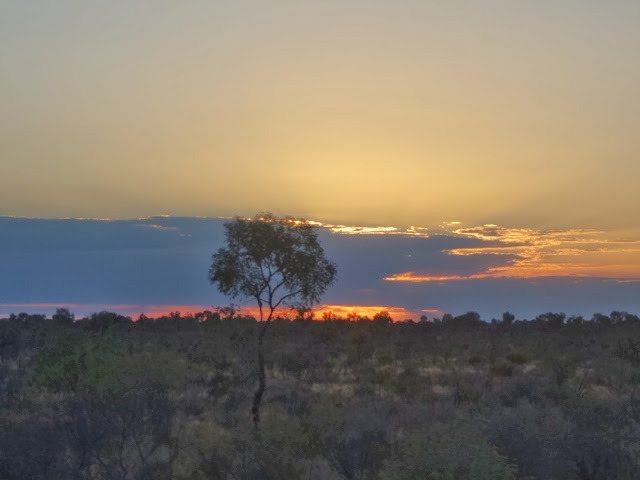
Sunrises and sunsets out in the desert are pretty spectacular, there's very little in the way of trees to break the unending horizon. 
Altogether now...  Sun-a-rise early in the morning!
Moonrise at dawn over the outback.

One is really impressed with a sense of isolation, despite being surrounded by other punters. The train for just a few minutes twice a week, is almost the only human presence in this enormous extraordinary expanse of red desert. Though many of us were barely there at all, mostly dozing, glimpsing the unfolding landscape through a drowsy dreamtime.

Why is it called The Ghan? In the early years of colonial pioneering, various brave men set out from the southern cities to find a path to the northern coast. After many failed and sometimes fatal attempts, a transcontinental route was found and a telegraph line was built, cutting communication time between England and Australia from a few weeks, to a few minutes. All of these exploratory missions across the burning heart of the country were supported by camels imported to Australia from Afghanistan, hence, Ghan. Many of their Afghan handlers stayed and married with european colonials and indigenous peoples, and their presence is still very discernible.
On the second day, after leaving Alice Springs, things started to heat up. We noticed a rather flustered looking engineer marching up and down between the carriages. Summer is always hot in the red centre of Australia, but apparently things were getting freakily scorching outside, and the air conditioning was at breaking point - she cannae take it anymore Captn. A whisper went round that the thermometer on the outside had reached 55°C !  The right side of the train, facing the sun, was actually too hot to touch, and everyone moved across to the seats in the left. The head conductor came through, apologising and confirming the astonishing out door temperatures. It was quite a contrast from the Trans-Siberian permafrost.


Between Darwin and Alice, there were many spare seats which allowed us to stretch out in comfort. even after Alice Springs, where we picked up several more passengers, I managed to have a pair of seats to myself. I could have stayed on the train for much longer, but arriving in Adelaide at lunch time on the third day, I was keen to get into town and find somewhere to stay. 

Here's a little collage made up from views through the vestibule window across the 50 hour trip.


Sunday, 29 December 2013

16th Dec - Wallace & Darwin

What better place to remember the centenary of Alfred R. Wallace's death than here in the city of Darwin, Australia. At the Museum and Gallery of the Northern Territory they're doing just that.


Here's a bit of surprising chronology: The city here wasn't founded until 1869. The tiny settlement was originally called Palmerston, after the then British PM. Thirty years earlier when the HMS Beagle sailed up the uncharted channel, John Clements Wickham the surveyor onboard, named the whole area Port Darwin, after the 24 year-old naturalist who had accompanied them on the same ship three years earlier. The young man had clearly made quite an impression. The Origin of the Species was finally published in 1859 to an initially mixed reception, but it's ideas took root and grew, until in 1911 the city of Palmerston was renamed Darwin in his honour.

Alfred Wallace was fourteen years younger than Darwin, but they were well acquainted with each others' work and exchanged correspondence for many years. They worked in slightly different areas of naturalism but their theories on evolution converged in 1858 when Wallace sent his famous letter to Darwin, and the latter realised the young man was hot on his heels. Darwin published his long-gestating work soon after receiving that correspondence. The exact timing of this episode is the subject of some speculation, some of it less than flattering for Darwin who was obviously defensive in protecting the exclusivity of his life's study.

Avid readers may recall me recently going on about crossing the Wallace Line by plane and boat. Here in the exhibition were displays that elucidated his theory, and how it was expanded upon and named as such by later scientists as the details of the movement of tectonic plates was learnt. Basically, he looked at the limits of distribution of species type across the islands, working out how some species on different islands shared appearances and traits, and others did not, and from that deduced a line of historic separation in fauna that ran north-south between Bali and Lombok. He concentrated on butterflies and moths as well as making extensive collections of beautiful birds of paradise. In fact, he mostly funded his expeditions by shipping home exotic species to collectors.

In addition to this he wrote on ethnography, anthropology, and primatology, and his book The Malay Archipelago (which has never been out of print) as well as setting out his theories on zoological distribution, was also a well received proto-travel guide to the islands that are now Indonesia, Malaysia, and Papua. This is all after spending several years on previous expeditions up the Amazon.
Here's a photo taken in Singapore, the base for his eight-year series of expeditions to the islands, when Wallace (on the right) was my age. Nice hat, good suit.
This astonishingly beautiful archipelago is the Wajag Islands off the north-west coast of PNG. Not such a bad place to do fieldwork I guess. 

Lots of butterflies - look at no.9, it's the same Swamp Tiger that we saw mating in their droves in Gili Meno - here it is in Australia. Wallace was certainly onto something. 

The MAGNT also features several permanent exhibitions, including one on the native fauna and flora of Australia. I now know the difference between Bilbies and Bandicoots, Quolls and Echidnas. 

Also on display was a fascinating exhibition on Aboriginal art, particularly rock painting. Included is a facsimile of what the museum claims is the oldest painting in the world, apparently depicting a Palorchestes (see rendering below) which went extinct 46,000 years ago (by human hand?). This claim would be disputed by the archaeologists who proffer 75,000-100,000 year old paintings at the Apollo 11 site in Africa. It's all pretty difficult to determine though because the ochre pigment used by the early Australians is non-organic and therefore can't be carbon dated.

In terms of the diaspora from Africa of Homo Sapiens Sapiens, the earliest people left the rift valley around 130,000 and their distant descendents finally arrived in Australia around 60,000 years ago. Earlier ancestors of man, for instance Homo Erectus reached the nearby islands of Java and Flores  much earlier though, 1m and 0.8m years respectively. 

Wallace believed that Oran Utangs were the closest of the apes to humans (chimpanzees are), but this was at a time when the origins of humanity were being traced to the Malay Archipelago, rather than central east Africa. 

As an interesting footnote, it's worth considering where Homo Floresiensis fits into the whole anthropological picture, these little fellas discovered in 2003, were apparently coexisting with modern humans on that isolated island next to Komodo, until 12,000 years ago, perhaps even later; maybe, one or two have speculated, they still exist... ://en.wikipedia.org/wiki/Homo_floresiensis

And here we are thinking we're the be all and end all of human civilisation...